Ricordo di un Panino alla Mortadella by Massimo Bottura
Massimo Bottura had taken mortadella, the thinly-sliced sausage of Italian school lunches, and distilled it into something close to a perfume. What reached the plate was the texture and memory of a childhood sandwich, whipped into a mousse as light as air, and that was the moment a well-organised wine tasting turned into something else.
The tasting, led by Filippo Bartolotta for the Cecchi family, had begun in the usual way. The wines were lined up from left to right, from older, terracotta-coloured Chianti through to the newest bright purple wines from Maremma on the Tuscan coast. In the middle sat the first vintage of Coevo, the 2006, a blend drawn from both places. I assumed the food was there because Tuscan Sangiovese is often at its best with something to eat. Then Bottura came out of the kitchen, and it became clear he hadn’t come just to cook. He was there to interpret the ideas behind the wine through his food.
At the time, his restaurant in Modena, Osteria Francescana, held two Michelin stars and had been ranked sixth in the world*. His ideas came as thick as aged balsamic and as fast as a Ferrari, two of Modena’s other famous products. A modern chef, he told us, needs his feet on the ground and his head in the clouds, at which point the Cecchi family stepped in to call a pit stop, and we went back to the wine.
The dream of the child
“I need memories and dreams,” Bottura said, introducing his first dish, Ricordo di un Panino alla Mortadella, the memory of a mortadella sandwich, “the past and the future.”
Like children all over Italy, he had gone to school with a sandwich in his bag, and he had turned that everyday memory into something close to science fiction. The mortadella had been distilled into water, and what remained was its smooth texture and flavour in the form of a mousse, served with crisp gnocco fritto, garlic cream and pistachios. Walter Pater wrote that all art aspires towards the condition of music, and I began to wonder whether all flavour aspires towards the condition of perfume. When I was a child, this was how I imagined food would be in the twenty-first century.
The sky and the earth
The dish was both past and future, Bottura’s response to a wine that brings together two very different parts of Tuscany: traditional Castellina in Chianti and the newer vineyards of the Maremma coast.
Chianti sits at the heart of Tuscany, and in 1716 Cosimo III de’ Medici set its boundaries down in law, making it one of the first wine regions to be formally defined. Its main grape is Sangiovese, a name often traced back to the Latin for “blood of Jove”. The Cecchi family also grow Cabernet Sauvignon there, which has developed a voice of its own in Tuscany. Maremma is a different story. Its rise as a fine wine region is far more recent, and it’s where the French varieties have thrived. Closer to the sea, its wines have a blue tint I don’t find in Chianti, and Coevo sets out to combine the best of both.
The meal ran to five dishes and ended with another play on past and present, the Croccantino di foie gras. Shaped like an ice lolly, it was foie gras coated in caramelised Piedmont hazelnuts and almonds from Noto in Sicily, with a liquid centre of 35-year-old traditional balsamic vinegar from Modena. Each element interpreted the wine, with north and south side by side, and a childhood treat made from foie gras, which Bottura cheerfully called one of the most adult and snobby foods there is.
So what can I tell you about the wine, other than that it was buonissimo, and that its first vintage won Gambero Rosso’s Tre Bicchieri? Coevo avoids the excesses of both regions. It has Chianti’s mouth-watering tannins without the searing dryness, and the opulent fruit of Maremma with a cool, blue-tinged edge. It takes the modern style made famous by the Super Tuscans and fills it with references to the long history of Chianti, so that, like Bottura’s mortadella, it’s a memory of Italy and a dream of the future.
And like all good dreams, there’s something blue about it.
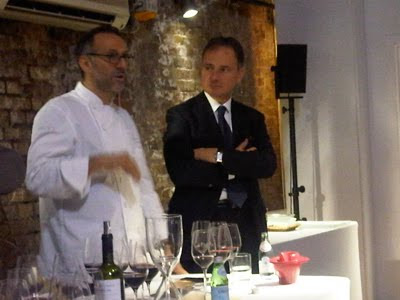
“I need memories and dreams,” continued Bottura, as he told the story behind his first dish, Ricordo di un Panino alla Mortadella (roughly translated as remembering Mortadella sandwiches), “the past and the future.”
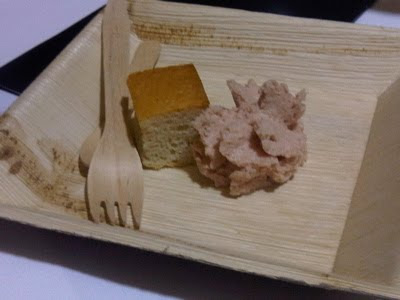
Ricordo di un Panino alla Mortadella (spuma di Mortadella, gnocco croccante, crema d’aglio e pistacchi)
An “Icecream Popsicle” of Foie Gras with a centre oozing with 35-year-old Balsamic covered in Piemonte hazelnuts and Sicilian almonds. Each element an interpretation of the wine: North and South, childhood treats in the form of the most “adult” and “snobby foods” (Bottura’s words), foie gras.
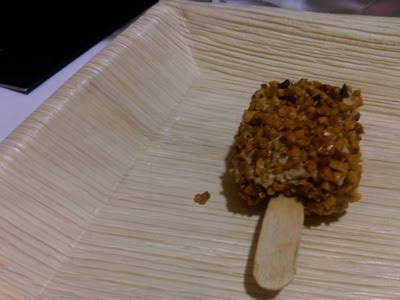
Croccantino di foie gras (Fegato grasso con mandole di Noto e nocciole di Piemonte caramellate e il cuore liquido di Aceto Balsamico Tradizionale di Modena).
Archive note: This post dates from 2010. Osteria Francescana went on to win a third Michelin star and was named the best restaurant in the world by The World’s 50 Best Restaurants in 2016 and 2018. Thank you to Filippo Bartolotta, the Cecchi family and the mighty Ben Smith of Enotria UK for the tasting at Vinopolis in London, held during Identità London.

